




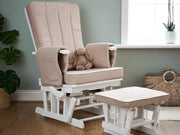


Savannah Swivel Glider Recliner Nursing Chair – Pebble
Secure checkoutSSL encrypted
- 360-degree swivel & glide
- Smooth manual recline
- Lumbar & head support
- Width
- 80.0cm
- Depth
- 75.0cm
- Height
- 110.0cm
Features
Mechanisms and construction
Core Features & Benefits
- Compact Space-Saving Profile: Sleeker profile ideal for smaller nurseries without sacrificing comfort.
- 360-Degree Swivel & Glide: Full rotation and silent ball-bearing gliding.
- Smooth Manual Recline: Easily adjust recline angle via a discreet side lever.
- Lumbar & Head Support: Ergonomically shaped cushions to support your back during night feeds.
- Heavy-Duty Frame: Reinforced hardwood and steel base.
Everything you need to know
Product details
Product details
Savannah Swivel Glider Recliner Chair provides combined swivel, recline, and gliding seating for nurseries, living rooms, or reading corners. It features a tall upholstered back and supportive foam cushions engineered for daily use.
- Dimensions: W 80 cm × D 75 cm × H 110 cm for accurate placement planning.
- Swivel motion: 360° rotation without repositioning the base.
- Gliding mechanism: metal ball bearings deliver smooth back-and-forth movement.
- Recline feature: Leggett & Platt hardware adjusts backrest to varied angles.
- Construction: hardwood and composite materials provide structural stability.
- Cushioning: foam padding retains firmness under regular use.
This chair combines multiple motion functions within a durable frame, supporting routine seating while preserving unobstructed floor areas in compact interiors.
Delivery & Returns
Delivery & Returns
- United Kingdom:Free delivery
- Order cut-off: 12:00 PM (UK)
- Handling time: 1–2 business days
- Estimated delivery:2–4 days
- Return window: 14 days from delivery
- Condition: Unused, original packaging
- Return postage: Paid by you (free on faulty items)
- Faulty items: Full refund or replacement
- Restocking fees: None
- Refund processing: Within 10 business days
Frequently Asked Questions
Frequently Asked Questions
What is a nursery chair or glider?
A nursery chair (often a glider or nursing chair) is seating designed for feeding and settling a baby — stable base, supportive back, and a motion that is calmer than a loose lounge chair.
Which nursery chair type should I choose?
Swivel glider recliners suit night feeds; electric recliners free your hands; glider-and-stool sets add leg support; solid wood rockers give a classic rock. Match motion and footprint to your room.
Is a glider better than a nursing chair rocker?
Gliders move on a fixed track (smooth, quiet); traditional rockers arc on curved runners. Many parents prefer gliders for small UK nurseries because the chair stays within a known footprint.
What fabrics and colours are available?
Ranges include bouclé, teddy, woven and tweed in colours such as Oatmeal, Stone, Pebble, Truffle, Olive, Ivory, Sand, Grey and Cream — see the options on this product.
Is UK delivery included?
Yes — free UK delivery is included on nursery chairs in this range as stated at checkout.
Can I use a pregnancy pillow with a nursery chair?
Yes — a pregnancy or feeding pillow on your lap pairs well with a glider for night feeds; many parents keep a U-shaped pillow after birth for that reason.
What height considerations are important for a nursing chair?
The Savannah chair's proportions ensure your feet rest flat on the floor while seated, promoting proper posture and reducing strain on your legs and lower back. The tall backrest supports your upper body, and the seat depth allows you to sit back comfortably while keeping your knees at a comfortable angle.
How does the 360-degree swivel help with nursing?
The 360-degree swivel allows you to turn towards a dresser, changing table, or window without disturbing your baby. This reduces strain from twisting your body and makes it easier to reach items while keeping your baby settled.
What reclining mechanism does this chair use?
The chair features Leggett & Platt hardware for adjustable backrest angles, allowing you to find the perfect position for feeding, reading, or relaxing with your baby.
